Why to book your flights with Din Tur
Les mer

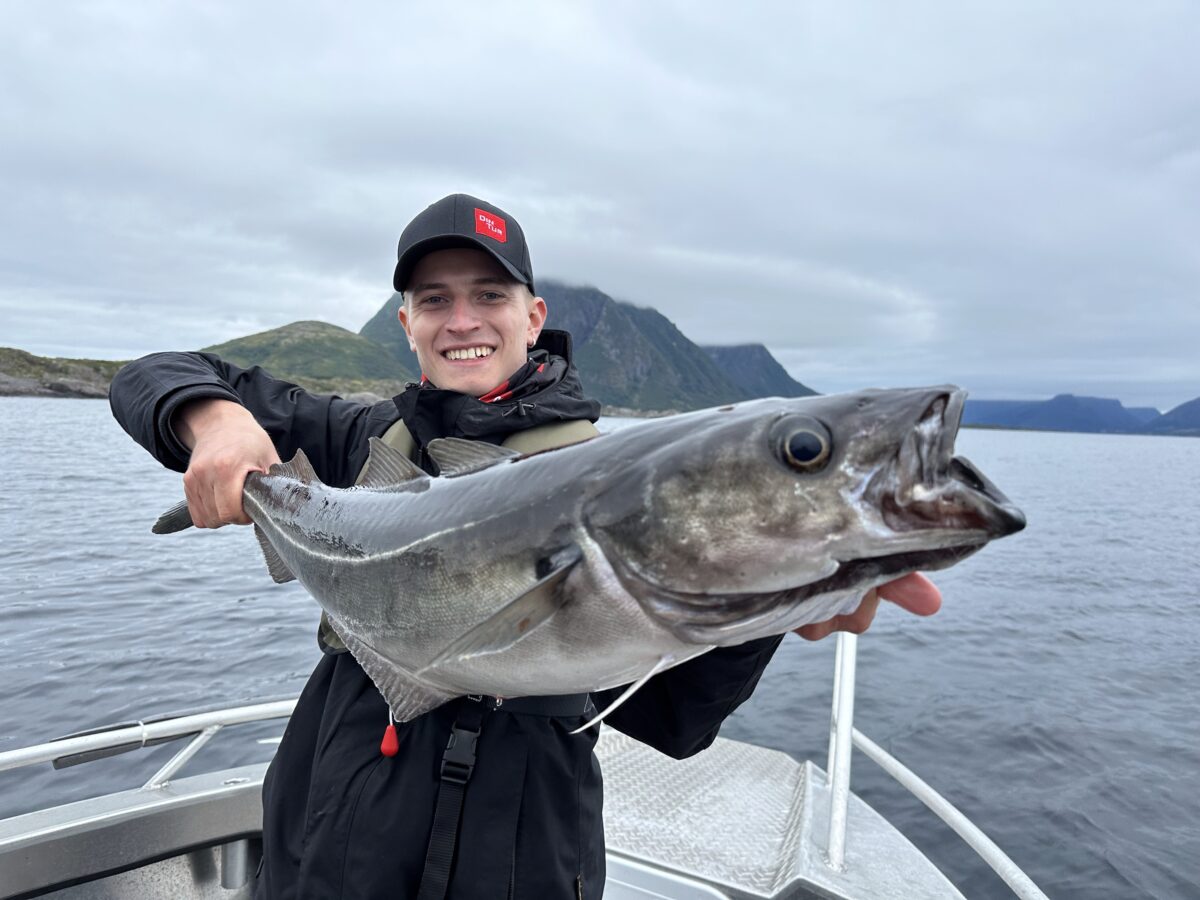
Catching a large coalfish weighing more than 10 kilograms is a lifelong dream for many anglers in Norway

Coalfish, also known as pollack, is a classic schooling fish and plays an extremely important role in commercial fisheries. But this species is not only significant for professional fishermen – for recreational anglers, but Coalfish is also one of the most exciting target fish of all. Its tremendous fighting power, speed, and stamina make it one of the toughest fighters in the sea and a firm favorite among anglers fishing in Norway. In the personal rankings of many anglers, saithe holds second place, right behind the halibut.
Habitat and Behavior of Coalfish
Coalfish can be found along the entire Norwegian coastline. Particularly important spawning and nursery areas are located on the Mørebanken banks and in the Varangerfjord in the far north. From an early age, young fish grow up in coastal regions before gradually expanding their range and becoming far more mobile.
Large, fully grown coalfish are usually found pelagically in open water or close to the seabed above deep areas. One of the defining characteristics of Coalfish is its constant movement. It is an active predator that relentlessly follows its prey. Its primary food source is herring, but it also feeds on smaller fish such as sand eels (“grill”) as well as shrimp. Where there is food, coalfish is usually not far away.

Catching a large coalfish weighing more than 10 kilograms is a lifelong dream for many anglers in Norway. This naturally leads to the recurring question: where and how do you have the best chances of landing a truly big saithe?
The answer is not entirely straightforward, but one thing is clear: Central and Northern Norway offer the best conditions. The period from mid-August to mid-October is considered the absolute prime season for trophy coalfish. During this time, large predators move very close to the coast as they follow the massive herring shoals that migrate to the Norwegian coast each year to spawn.

At this time of year, large saithe are often found around deep plateaus in water depths of 100 to 200 meters, especially where underwater reefs rise to 20–60 meters. These structures act as natural hunting grounds where baitfish tend to concentrate.
However, open water should not be underestimated. Enormous herring schools often move pelagically through fjords and coastal areas – and large saithe follow them. I have personally experienced saithe exceeding 10 kg aggressively attacking whole baitfish in mid-water.
The truly large specimens are often positioned above water depths of more than 100 meters, hunting in water layers just below the surface. A very good indicator of this activity is the presence of seabirds, dolphins, or even whales, all of which also target the herring. Wherever there is intense surface activity, it is always worth taking a closer look.
Lure Choice: Soft Baits Instead of Metal
In these situations, large soft lures of 20–25 cm perform particularly well. They allow for more selective fishing for big fish and help to reduce unwanted bycatch. Especially in open water, large soft plastics often outperform metal jigs, as they appear more natural and remain in the fish’s field of vision for longer.
Choosing the Right Area – The Best Regions for Trophy Coalfish
Central Norway (Trøndelag)
Areas such as Hitra and Flatanger are classic destinations for good Coalfish fishing and deliver consistently throughout the year. The key here is to specifically target offshore plateaus. The preferred fishing method is light to medium tackle using rubber lures or jigs weighing between 80 and 150 grams.
Nordland – Lofoten & Vesterålen
My personal number one is the catchment area of the Vestfjord near Bodø. The region around Mevær, in particular, is legendary. Everything moving toward the Saltstraumen has to pass through here – an absolute bottleneck for fish.
A quick look at the seamap is enough to guarantee sleepless nights: countless plateaus, drop-offs, and underwater reefs. Many trophy coalfish over 20 kg are caught here in surprisingly shallow water, sometimes at depths of just 20–30 meters. The Saltstraumen itself is difficult to fish due to its extreme tidal currents. Most large fish are not caught in the Saltstraumen there are caught in the fishing ground out from Bodø
Steigen & Vestfjord
The Steigen area around Nordskot Brygge is another top-class fishing area. Short distances, to the best fishing grounds and direct access to the Vestfjord make this area particularly attractive.
Andfjord – Senja
The Andfjord, with its many good plateaus and shallow reef is also one of the best trophy coalfish areas in Norway. Places such as Grytøy, Frovåg, and Kastnesham offer excellent starting points that put you right on the fish.
Once you have chosen a region, the nautical chart becomes your most important tool. Pay special attention to:
• Shallow reefs near deep water
• Plateaus which coming up for the deep sea
• Structures leading from deep water into shallower areas
On the fish finder, large coal can often be distinguished well from baitfish. They usually appear as elongated lines or sickle-shaped marks above the schools. Trophy coalfish often hold on the edges of underwater reefs where they hunt smaller saithe and baitfish.
In autumn, many large fish follow the herring far into shallow

A proven setup is a 20 lb rod combined with a multiplier reel in the PE4 class. Anglers who prefer spinning gear are well advised with rods rated 10–20 lbs and 4000–5000 size reels. A multi-coloured braided line is extremely helpful for presenting the lure precisely at the desired depth.
Lures and Presentation
I almost exclusively use soft lures between 20 and 25 cm in length. Depending on the spot and what the fish finder shows, I let the lure sink precisely to the indicated depth and then retrieve it evenly at medium speed all the way up to the surface.
If the lure is dropped all the way to the bottom, the likelihood of bycatch such as cod or halibut increases significantly. Speed jigging can also work, but in my experience, it tends to result in more average-sized saithe rather than true giants.

Conclusion
Coalfishe is one of the most exciting target species in Norway. Those who understand its behaviour, choose the right regions, and fish selectively with large soft plastics have a realistic chance of landing a dream fish weighing over 10 kilograms.
Patience, observation, and thorough preparation are the keys to success.
Tight Lines