Why to book your flights with Din Tur
Les mer

The fish of a lifetime—a halibut over 50 kg—is a lifelong dream for many anglers in Norway. Question often arises: Where and how do you have the best chances of landing a really big halibut?

Growth and Life Cycle of the Atlantic Halibut: The halibut is a deep-sea spawning fish. Adult Atlantic halibut spawn at depths of 300 to 700 meters, often in deep fjords or at known spawning grounds near the continental shelf. The spawning season lasts from December to March. The Atlantic or white halibut can live up to 50 years and reach a weight of over 300 kilograms.
Habitat and Behaviour of the Halibut
Small halibuts often spend their first 3-4 years close to the coast in sheltered, shallow bays and fjords. As they grow older and reach sexual maturity, they gradually seek out deeper waters.
Site-Specific Behaviour:
Halibut are generally very site-specific. They may remain in the same areas or return to the same spawning grounds year after year. This is very important information for us anglers.
You often hear “You have to fish on sandy plateaus,” but that’s just one of the many myths. Sandy plateaus offer little food or prey. Halibut can rest in such places, but they hunt where there’s current and prey, which is found in channels, drop-offs to deep water, and plateaus.
Halibut fishing spots vary greatly depending on the season, but the best spots generally have similar bottom and current conditions. Sandy channels and sandy bottoms mixed with plants and rocks: Halibut love gravel or shell sand as a substrate, to which they can perfectly adapt.
Look for plateaus with access to deep water. Shallow channels between reefs are always a hotspot and abruptly dropping offs into deeper water are ideal hunting grounds for halibut. Redfish spots are also popular for halibuts; these often have corals teeming with life and offering easy prey. Halibut often migrate to shallow plateaus to hunt.
Tidal currents and straits: Halibut thrive in areas with strong currents. Sandy and narrow channels or shallows amidst strong tidal currents crowd together small fish, attracting hunting halibut.

Anyone who wants to successfully fish for halibut must consider fundamental factors such as the fishing area, the time of year, the tides, and the moon phases.
The moon phases are one of the most important factors when fishing for halibut. Whether it’s a full moon or a new moon is secondary, as long as you take one of the two phases into account. The best time to fish is generally four days before to four days after a full or new moon. During this time, the tidal range is greatest, the water movement is enormous, and the fish are very active.
Halibut prefer areas with strong currents. Sandy, narrow channels or shallow areas amidst strong tidal currents often harbor prey such as smaller fish, crayfish, crabs, and sea urchins, and are therefore ideal hunting grounds for halibut. These locations are extremely influenced by the changing moon phases and, of course, affect success.
There are differing opinions on whether low or high tide is better. I think it depends on the specific fishing spot and the prevailing current direction there. In some areas, halibut bite more readily at low tide because the current is strong when the water flows back from shallow areas and currents. Conversely, when the tide is rising, the opposite can be true; there is then no movement in the sea, and the predators are not in a feeding mood.

Early spring
After spawning, halibut often return to shallower waters, frequently at depths of 10-40 meters, to fatten up by feeding on small fish. Note that the spawning protection period applies (and north of 62°N, extended protection until April 20th).
The period from mid-April to early June is, in my opinion, the best time. The first fish to return to shallow water are the males, which tend to be smaller than the females, which are leaner and weaker after spawning. Here, hungry halibut pounce on anything that crosses their path. Crabs and lumpfish are welcome prey, as they are slow-moving and highly nutritious. Also, because there aren’t many small fish in the shallows in early spring, the halibut feed primarily on bottom-dwelling creatures. In these shallow waters, the fish often follow the bait right up to the surface.
Summer months
During the summer months, halibut stay close to the coast in shallower waters, where most sport anglers’ fish for them at depths of 15-60 meters. However, many of the larger specimens are often caught as bycatch or deliberately targeted at depths exceeding 100 meters. They are frequently caught as bycatch while fishing for redfish, and the average weights are significantly higher than in shallow water. Large fish often go for smaller ling that are reeled up from the depths. Anglers often pause because their arms ache from reeling, and then suddenly, BOOM, everything is snagged 100 meters above the seabed. And that’s when things get really interesting, because a fish over 100 kg doesn’t attack the bait; it simply inhales it, and the rod just bends completely round.
As already mentioned, the spots where you catch redfish are really hot spots. In summer, there’s plenty of food, coral, and also lots of coalfish with good average weights. This is where the really big fish are.
Underwater mountains around 80-90 meters deep, surrounded by deep water, are also often good spots for large halibut. Fish over 2 meters long are frequently hooked here.
Autumn and Winter
From the end of October, the fish migrate to deeper water. The transition is gradual, as if the fish are leaving the shallower waters step by step until they reach their spawning grounds in mid-December. These grounds are generally located at depths of 150-350 meters, and the seabed is usually clay and loam, surrounded by isolated coral reefs. These depths are very difficult for us to fish at this time of year, and the closed season runs from December 20th to April 20th.
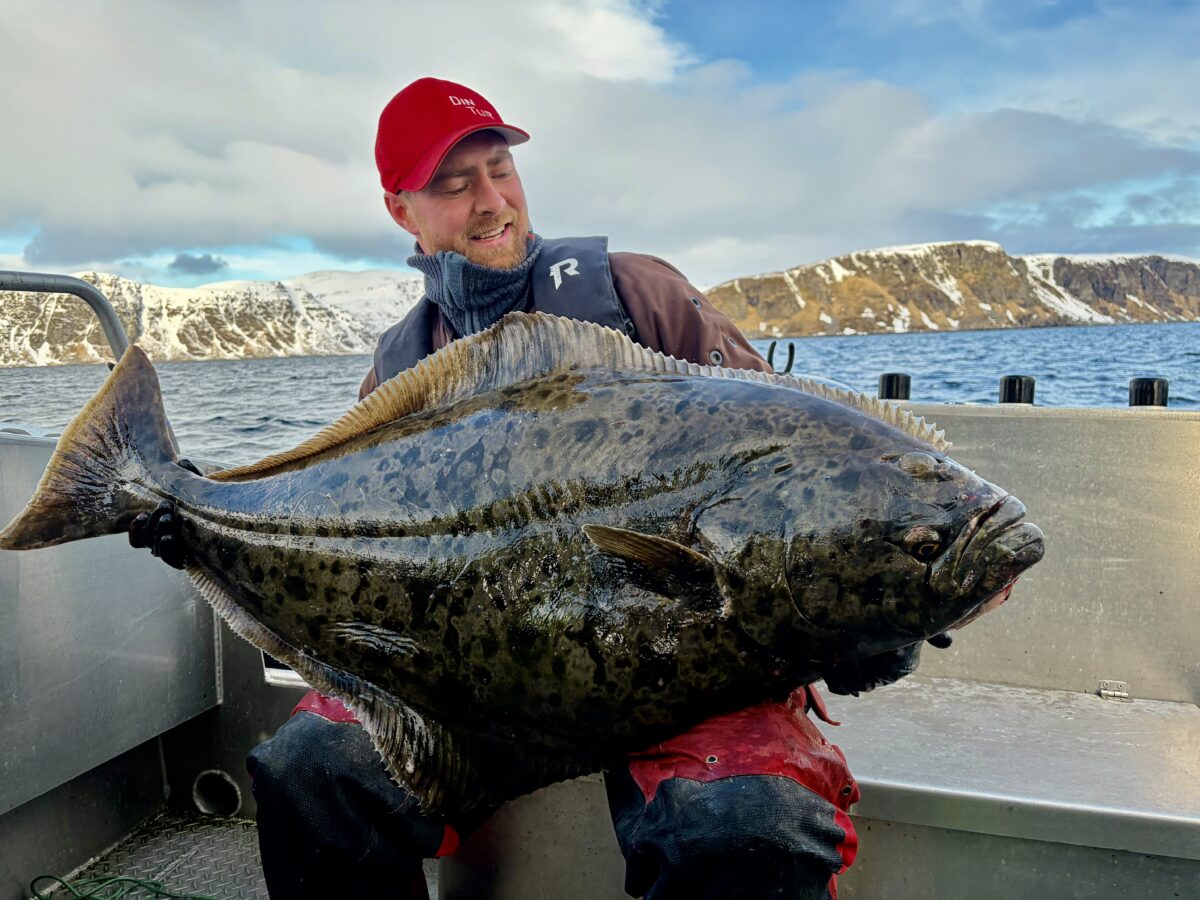
The fish of a lifetime—a halibut over 50 kg—is a lifelong dream for many anglers in Norway. Question often arises: Where and how do you have the best chances of landing a really big halibut?
Our answer is simple!
You should plan your trip north of the Arctic Circle.
Nordland offers the best conditions in this regard. The region around Vega and further north, with Træna, Myken, Mevær, and Nordskot Brygge, you’ll find some of the best fishing grounds in the entire north.
Vesterålen and Senja
Great fishing grounds like Elgsnes Gård, Grytøy, Kastneshamn, Skrollsvik, and Frovåg are top choices here.
Troms and Finnmark
Burøysund Brygge and Visit Arviksnad are perfectly situated here, with Amberfisch, Vengsøy, and Sjursnes you have good choices as well.
Finnmark
In the northern part of the region, my clear number one is Sørøya Rorbur, where there seem to be inexhaustible quantities of halibut. Neverfjord, Loppa, and Korsfjorden are also excellent starting points for catching your dream fish.
Those who want to try even further north should try North Star Fishing Lodge and Båtsfjord Brygge; the chances are very good there.
One thing is certain – halibut doesn’t forgive any weaknesses on equipment. It’s essential to have good equipment.

Be in the right place at the right time, and you’ll be one step closer to your dream fish.
Tight lines